
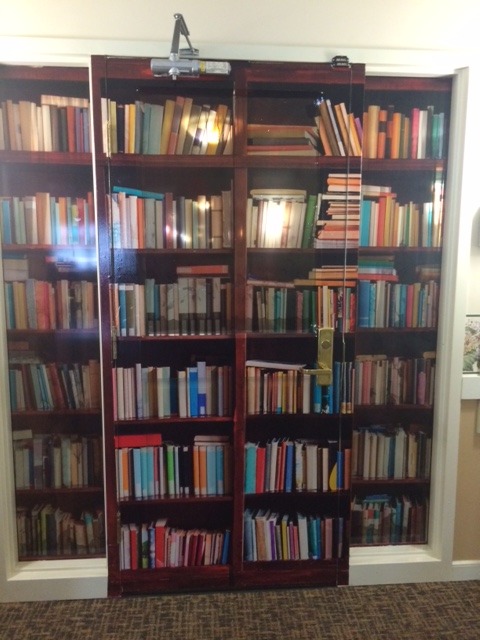
About a month ago, I put a vinyl decal of a bookshelf over one of our doors in Memory Care. It was a test, in my mind, to see if we could prevent residents from trying to exit through the door.
I’m happy to report that the bookshelf decal absolutely has worked. While a couple of my residents used to go through this door five to ten times a day, two residents have opened it twice in the past month. It has worked so well, in fact, that I’ve ordered a new decal for another door in the community. This bookshelf decal has worked so well that the residents who used to go through the old door now go through a door up the hall with no decal on it.
It’s amazing to see what a photo of a bookshelf has done to completely change the way my residents perceive the door. Dementia changes the way that the brain sees and understands information. While a flat photo of a bookshelf would look unreal to anyone else, people with dementia see it as real. The same thing goes for the baby dolls and stuffed animals we have in Memory Care. If it looks like a baby, feels like a baby, and is the same size and weight as a baby would be, it becomes real to a person with dementia. Our brains are very pattern-seeking: they make sense of things that don’t necessarily make sense. Therefore, if something looks and feels real, it is real.
Dementia changes our depth perception awareness, our eyesight as a whole, and the way we understand color in relation to space. This is also why, if you put a black floor mat down on the ground, many people with dementia will see it as a hole.
By utilizing the deficits that the disease brings, we can actually make the world a better place for people with dementia when we do things like disguise doors and provide baby dolls.


